Fridge not cooling
We check the compressor, thermostat, fan and refrigeration circuit and find out why the cabinet is getting warm.

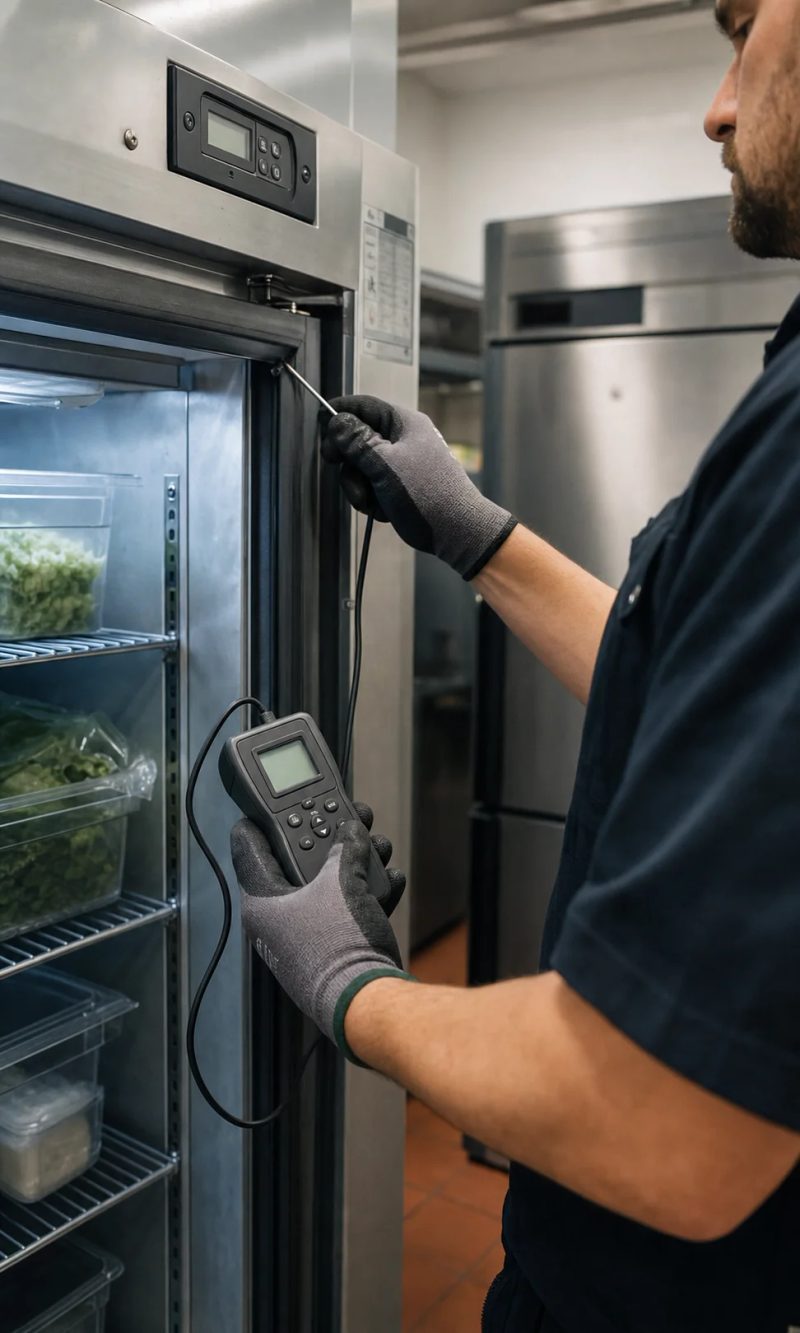
We have worked in refrigeration since 1995, and maintenance and repair are done by our own team. A fridge repair starts with finding the fault. On site, the technician measures the temperature and checks the compressor, thermostat, sensors, fans, defrost system and door seals, then explains what has failed and which work and spare parts are needed.
We keep the most common original spare parts in stock, so a fault can often be fixed on the same visit. With the priority service we reach you within two hours between 9:00 and 17:00 on working days. You can report a fault on +372 6729 533 or with the fault report form.
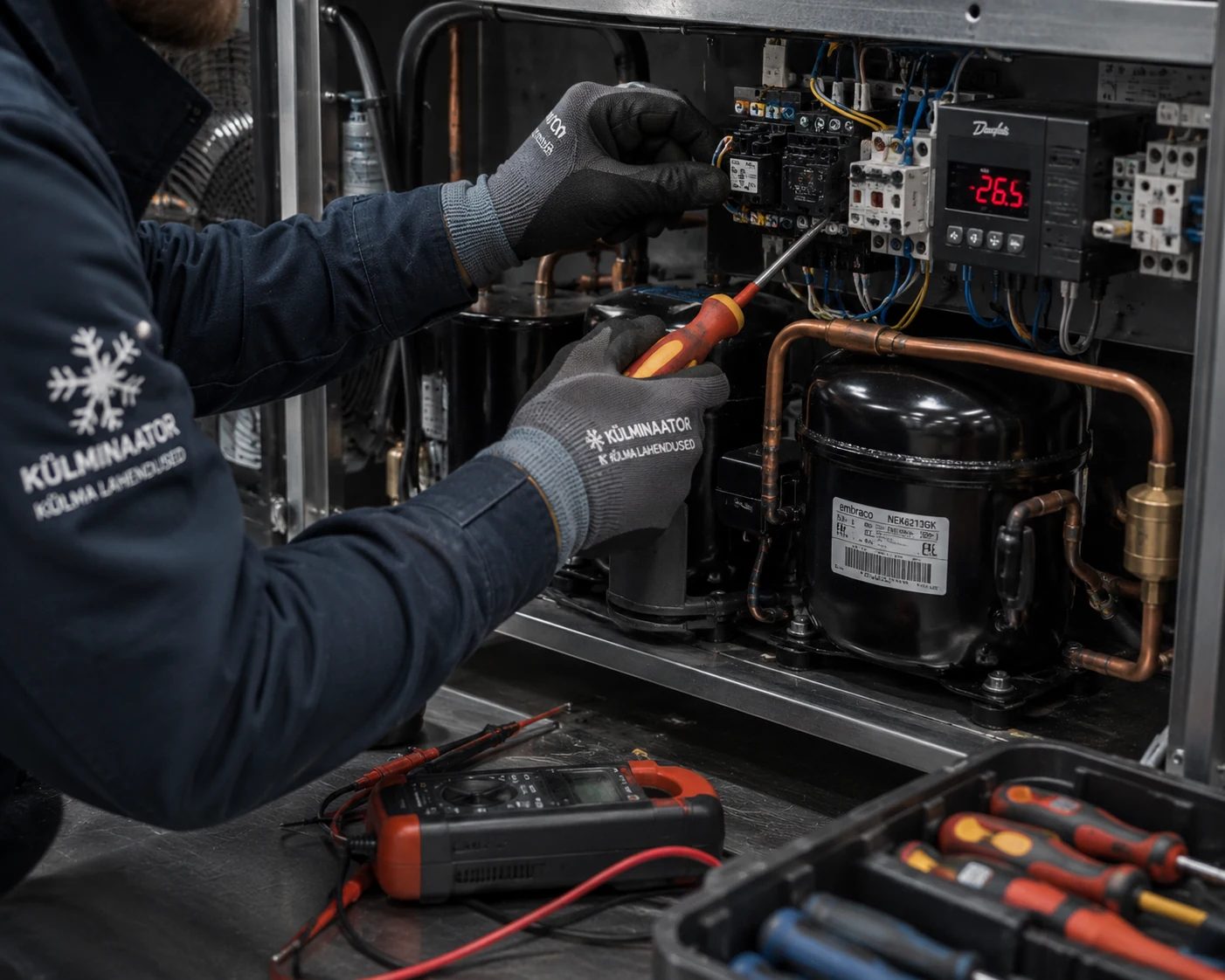
Külminaator's refrigeration repair service covers fridges, refrigerators and freezers in Tallinn, Harju County and elsewhere in Estonia. If a fridge stops cooling, runs without a break, leaks water or gets louder than it used to be, call a technician before the goods start to spoil.
We check the compressor, thermostat, fan and refrigeration circuit and find out why the cabinet is getting warm.
We trace the cause in the defrost system, sensors and refrigeration circuit before the goods start to thaw.
A faulty sensor, thermostat or controller keeps the cabinet too warm or too cold.
A faulty defrost heater, timer or sensor, or a worn door seal letting moist air into the cabinet.
We clear the blocked defrost drain and find out where the water is coming from.
Fan, compressor or start relay checked and replaced.
Dusty condenser, faulty sensor or a seal letting warm air in.
Start relay, thermostat, controller and electrical connections.
We find the leak, repair it and recharge the system.
We read the code, check the assembly it refers to and replace the faulty part.
Door seal, hinges and closers replaced and doors adjusted.
LED lighting, illuminated canopies and glass heating repaired.

A fridge runs around the clock. The compressor circulates the refrigerant, the evaporator draws heat out of the cabinet and the condenser releases it into the air in the room. This work is controlled by a thermostat, or by sensors and a controller. From the outside, different faults can look the same, so we always start by measuring, not by replacing parts.
If the compressor is running but the cabinet is not cooling down, the cause may be a refrigerant leak, a worn compressor or blocked pipework. We find the leak, carry out the repair and recharge the system with the correct amount of refrigerant.
If the unit will not start, shows an error code or holds the wrong temperature, we check the start relay, thermostat, sensors, defrost timer and controller, and replace only the part that has actually failed.
A dusty condenser forces the compressor to run constantly, an iced-up evaporator stops cold air from moving and a blocked drain puts water on the floor.
A worn door seal is one of the most common reasons a fridge runs too much and ice builds up on the evaporator. We replace seals, hinges, closers and locks, and repair glass door heating and lighting.
We measure the temperature and check the electrical parts, refrigeration circuit and airflow.
A new compressor, start components and recharging the system with refrigerant.
Finding the leak, repairing it, recharging the system and checking that it works.
Replacing a faulty thermostat or temperature sensor and setting up the new one.
Checking, replacing and setting up the controller and control panel.
Replacing evaporator and condenser fans and motors.
Checking and replacing the defrost heater, defrost timer and defrost sensor.
Cleaning a blocked defrost drain and the drip tray.
Cleaning, so the compressor does not have to overwork.
Replacing a worn or torn door seal.
Replacing hinges, closers, locks and sliding door rollers.
Replacing LED lighting, power supply units and illuminated canopies.
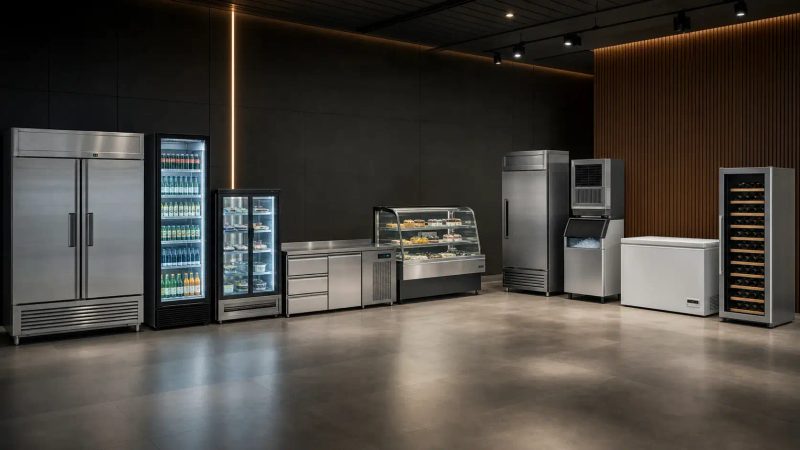
We repair glass door fridges and solid door fridges, single-door and double-door models, stainless steel kitchen fridges and fridge-freezers.
We repair upright freezers, chest freezers and chest coolers, with both glass and solid lids.
Drinks fridge and bar fridge repair covers drinks fridges, bottle coolers, bar fridges and impulse coolers.
Wine fridge and minibar repair covers single-zone and multi-zone wine fridges, hotel minibars and small fridges.
Refrigerated display case maintenance and repair covers refrigerated display cases and serve-over counters, multideck display fridges, cake and pastry display cases and ice cream display freezers.
The kitchen equipment we maintain and repair covers refrigerated prep counters, freezer counters, saladettes and blast chillers in restaurants and commercial kitchens.
Cold room maintenance and repair covers cold rooms and freezer rooms, monoblock units and outdoor condensing units.
Ice machine maintenance and repair covers cleaning, limescale removal and fault repair for ice cube machines and flake ice machines.
If repairing an old unit does not pay off, we say so plainly and help you choose a suitable replacement fridge or freezer. You can find a more affordable option among our used equipment.
Our daily work is refrigeration equipment for businesses. The priority service is for faults that cannot wait.
If you have several units or sites, sign a maintenance agreement: contract customers get a lower hourly rate and we respond to their call-outs faster.
In Tallinn we visit business sites in all districts: Kesklinn, Kristiine, Mustamäe, Nõmme, Haabersti, Lasnamäe, Põhja-Tallinn and Pirita. In Harju County we reach Viimsi, Maardu, Rae municipality, Saue, Keila, Saku and Kiili.
Outside Harju County we repair fridges by arrangement, for example in Tartu, Pärnu, Rapla, Rakvere, Viljandi and Haapsalu. For a more distant site we agree the arrival time separately.
By arrangement, you can also bring a smaller unit to our workshop.
The price of a fridge or refrigerator repair depends on the call-out, the actual working time and the spare parts and materials used. The rates in our service price list include VAT and are valid from 1 July 2025. Call-outs outside normal working hours, on days off, at night and on public holidays are by prior arrangement. The price list is not a quote for a specific job. Customers with a maintenance agreement get a lower hourly rate.
Call-out in Tallinn up to 15 km, working days 9:00 to 17:00
Call-out up to 20 km and outside the city, working days 9:00 to 17:00
Call-out outside normal working hours and on days off, up to 15 km
Call-out outside normal working hours and on days off, up to 20 km and outside the city
Call-out at night 22:00 to 6:00 and on public holidays
Labour hour on site, working days 9:00 to 17:00
Priority service labour hour, on site within 2 hours
Labour hour outside normal working hours and on days off
Labour hour at night 22:00 to 6:00 and on public holidays
Labour hour in our workshop, working days 9:00 to 17:00
Kilometre fee when the round trip is over 40 km
Minimum chargeable time
We also sell Tefcold, Gram, Vestfrost, Hoshizaki, Scotsman, Everlasting, Sagi and Scandomestic equipment ourselves, so we know the technical information and spare parts for these brands. See all manufacturers.
We also repair commercial refrigeration equipment bought elsewhere. Send the manufacturer, model and a description of the fault so we can confirm the work we can do and spare-parts availability. We do not repair household refrigerators.
Send the manufacturer and model of the unit, a photo of the rating plate and a description of the fault.
On site, the technician identifies the cause of the fault and the spare parts needed.
We carry out the necessary work. The final price depends on the actual working time and the parts and materials used.
We measure whether the unit is holding its temperature and give you a written summary of the work done.
If the unit still does not reach the right temperature after these checks, call our service line on +372 6729 533 or send a fault report. Do not take the refrigeration circuit or electrical parts apart yourself.
You will find a more detailed list on the page what to include in a repair request.
Planned maintenance helps to find the signs of a fault before the goods start to spoil: the compressor runs longer than before, the cabinet no longer holds its temperature, ice builds up on the evaporator or dust collects on the condenser.
During maintenance we check the condition of the unit, clean the condenser and evaporator, inspect the seals, fans and sensors, and measure whether the temperature stays within the specified range. You receive a written summary of the work done and our recommendations.
Ask about a maintenance agreement if you have several units or they run continuously.
The condenser and evaporator are cleaned so the compressor does not have to overwork.
Temperature, seals, fans, sensors and electrical connections.
On-site diagnostics and repair, with the most common original spare parts in stock.
A lower hourly rate and faster response for contract customers.
Common causes are a dusty condenser, a stopped fan, a faulty thermostat or sensor, a worn door seal, a refrigerant leak or a compressor fault. A fridge that runs constantly without cooling uses more electricity and wears out the compressor. If only the fridge section is warm, the cause is often a fan, the defrost system or an air duct. If both sections are warm, the cause is probably the compressor, the refrigerant or the controller. Refrigerant, also called Freon, is not used up: if the system is low, the leak must be found and repaired before recharging.
Common causes are thick ice on the walls or around the lid, a door left ajar or a lid that does not close tightly, a refrigerant leak, a worn compressor or a dusty condenser. A unit with automatic defrost (No Frost, for example) needs no defrosting by hand; if thick ice forms, the door seal, defrost system and fan need checking. Defrost a chest freezer or a freezer without automatic defrost when the ice is about half a centimetre thick: move the goods, switch it off, leave the door or lid open and dry the cabinet before switching it back on.
Water under a fridge most often means a blocked defrost drain, but it also appears when the door does not close tightly or the defrost system is not working properly. In many fridges, drops on the back wall are normal defrost water. Standing water in the cabinet often means a blocked drain hole: flush it with warm water and, if needed, a soft brush, but never poke it with sharp objects. If the water returns or the walls are wet all over, the door seal and temperature control need checking.
Noise usually comes from a fan, the compressor or the start relay, or from a unit on an uneven floor or a pipe touching the wall. A steady compressor hum, a short click at start or stop, gurgling or hissing refrigerant, fan noise and crackling during defrost are normal, as is warmth on the sides, the front edge and around the compressor. Call a technician if the noise is new or growing, repeated clicks do not start the compressor, or the casing gets hotter than usual and the cabinet cools less well.
With the door closed, a fridge generally stays safely cold for about four hours after cooling stops. Throw away perishable food that has been warmer than 5 °C for over two hours. If you do not know when the fault began, measure the temperature, and if in doubt, do not take the risk. A full, closed freezer stays cold for up to 48 hours, a half-full one for about 24. Do not refreeze thawed food. Glass door units and smaller units warm up faster. In a business, follow your self-monitoring plan and the product's storage conditions.
Between 9:00 and 17:00 on working days a call-out costs €43.40 (in Tallinn up to 15 km) or €55.80 (up to 20 km and outside the city), and a labour hour on site costs €68.20, all prices with VAT. The minimum chargeable time is 30 minutes. The final price depends on the actual working time and the spare parts and materials used. Finding the cause of a fault is part of the service work. All rates are in the service price list.
With the priority service we reach you within two hours between 9:00 and 17:00 on working days. A priority service labour hour is €99.20 with VAT. For a more distant site we agree the arrival time separately. We respond faster to call-outs from customers with a maintenance agreement. In the evening, at weekends, at night and on public holidays we come by prior arrangement, at the rates in the price list.
We keep the most common spare parts in stock. Compatibility and availability depend on the exact model, so a photo of the rating plate helps identify the correct part. If a part has to be ordered, we confirm the repair time after checking availability. On-site repair depends on the fault, access and spare parts: if work in the workshop or another visit for a spare part is needed, we confirm this before continuing. During a breakdown we rent out fridges, chest freezers and display cases as temporary replacements: state the period and location in your rental request.
Materials and spare parts installed by us carry a 12-month warranty, unless the sales documents say otherwise. A unit bought from us generally carries a 12-month warranty, and GRAM Bioline and GRAM Professional products carry a 24-month warranty: include the purchase date or invoice in your fault report. If a unit bought elsewhere is still under warranty, contact the seller before ordering a repair, because a repair done outside the seller's or manufacturer's service can void the warranty. The exact terms are on the warranty page.
Yes. Send us the model and a description of the fault and we will tell you whether spare parts are available.
No. We repair commercial refrigeration equipment. We do not repair household refrigerators.
If the fault is in the seal, fan or thermostat, a repair usually pays off. A new unit makes more sense if faults keep coming back, spare parts are no longer available, power consumption has clearly risen or a worn fridge needs a major repair. A fridge usually lasts 10–15 years, and for a heavily used shop or kitchen unit this can be shorter. Take an old unit to an electronic waste collection point and do not put it in ordinary waste, because it contains refrigerant: the collection points are on the disposal page.
Call our service line on +372 6729 533 or send a fault report with the manufacturer and model of the unit, the site address and a description of the problem. A photo of the rating plate, the error code and the date of the last maintenance help us prepare for the work. Also note whether it is an upright or a chest unit, what temperature it is showing, which section is not working and whether ice soon came back after defrosting. Before you book, confirm how the work is charged if you decide not to continue with the repair.
The maintenance interval depends on the manufacturer's instructions, the workload and the room conditions: dust, heat and long running hours can increase the need for maintenance. A suitable schedule can be set once the unit has been inspected. When you book, tell us whether the unit is in continuous use: before the visit we agree which areas need emptying and whether the goods need temporary storage. Any repair needs or additional work found during maintenance are confirmed separately. If we find a worn part or a need for further checks, the next job can be planned from the written summary.
Describe the unit and the problem: we will contact you and arrange the maintenance or repair.